
Medication intelligence for the complete medication picture.
IntractMD brings prescription medications, OTC products, supplements, foods, interactions and cumulative medication risk into one clinical decision-support platform.
No-cost pilot · No installation or EHR integration required to begin

Start with the story. Then explore the platform.
What is IntractMD?
Patient app walkthrough showing how medications, supplements and foods come together in a single interaction review.
IntractMD for patients, caregivers and health plans
A broader explanation of how the platform extends from patient-facing use into organizational medication-management workflows.
The medication list is not the whole medication picture.
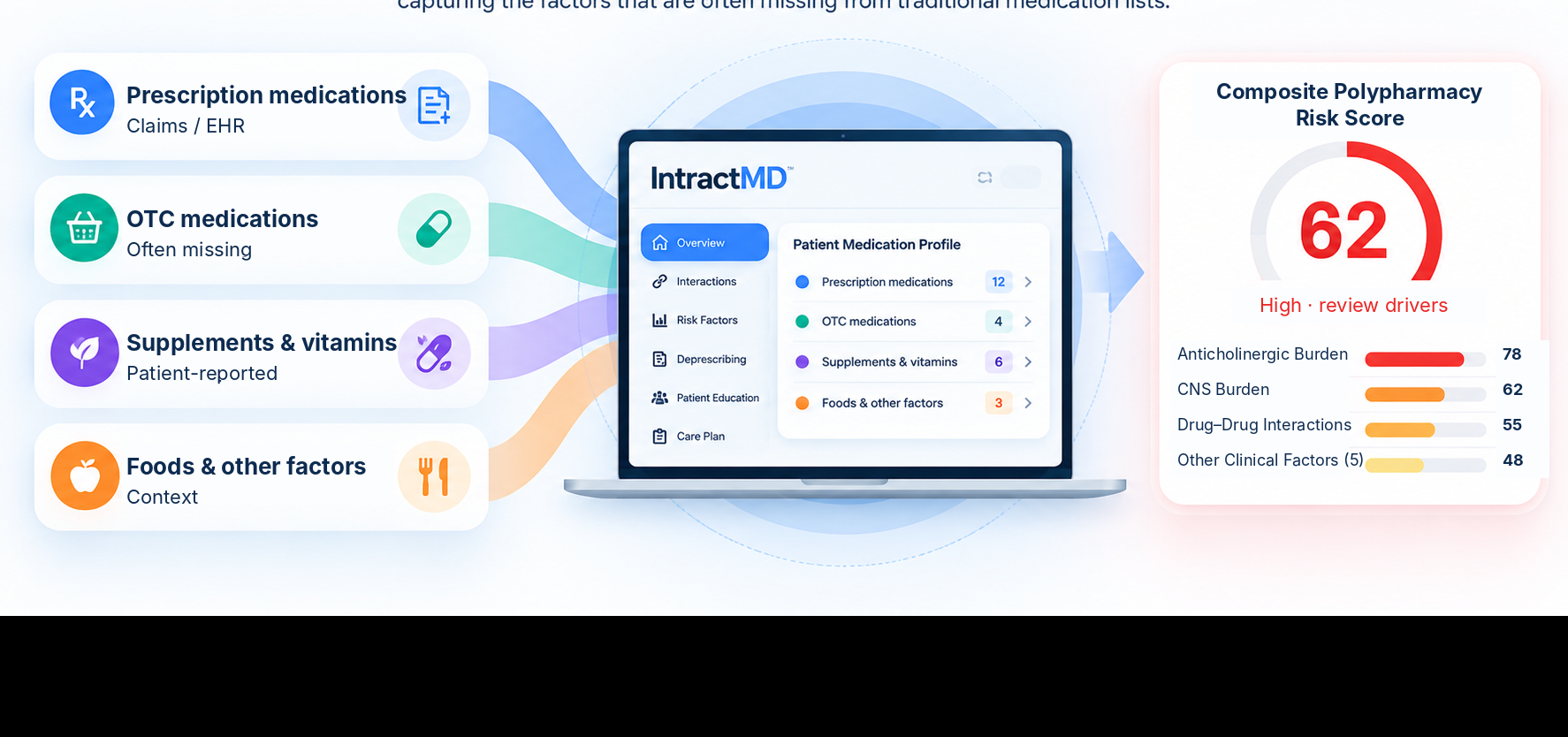
Prescription claims and EHR medication lists are essential — but they may not capture everything a patient is taking. IntractMD is designed to make the missing layer visible during medication review.
Prescription medications
Analyze the medications that are already visible to the care team.
OTC & supplements
Bring vitamins, herbal products and over-the-counter medicines into the same review.
Cumulative risk
Look beyond isolated interactions to patterns of polypharmacy and medication burden.
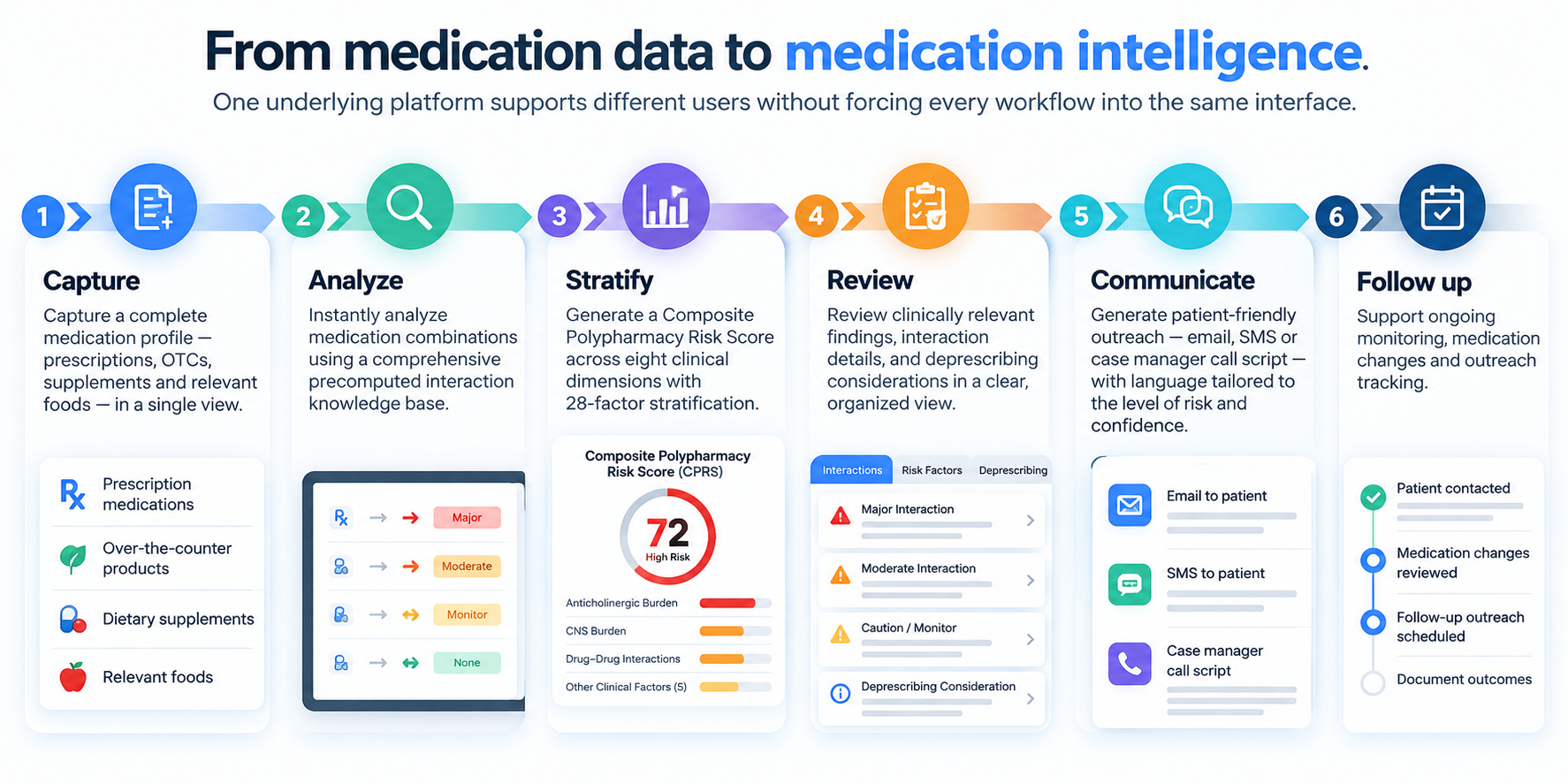
From medication data to medication intelligence.
One underlying platform supports different users without forcing every workflow into the same interface.
Four applications. One medication-intelligence layer.
Interaction Checker
Patients can screen prescriptions, supplements and foods together in plain language.
Try the patient app →Proactive Screening
Identify supplement and food risks across medication populations before the next adverse event.
Clinical Workflow
Structured medication-risk review with 28-factor stratification and confidence-tiered patient outreach in English or Spanish. Findings are distinguished as established, computed or AI-assisted predictive.
Deprescribing Intelligence
Model hypothetical medication-removal scenarios against AGS Beers, STOPP/START and CMS criteria, and surface candidates for pharmacist review.
See the risk. Understand the drivers.
IntractMD's Composite Polypharmacy Risk Score (CPRS) is a 0–100 clinical decision-support signal that synthesizes eight pharmacological dimensions across a medication regimen.
Explore the methodologyAnticoagulant, antiplatelet & additive bleeding effects
QT prolongation, arrhythmia & other cardiac effects
Sedation, respiratory depression & central nervous system effects
Overlapping serotonergic effects & serotonin syndrome potential
Small changes that can increase toxicity risk
Enzyme inhibition, induction & altered medication exposure
Clearance, accumulation & organ-function considerations
Additive or opposing effects across medications
CPRS is not a validated clinical instrument or outcome-prediction model. It is intended to support clinical review and does not replace pharmacist or physician judgment.
Medication safety is becoming a measurable quality issue.
Organizations are under growing pressure to identify medication-related risk systematically — especially in older adults and patients with complex regimens.
Designed to fit the workflows pharmacists already perform.
Health Plans & PBMs
Population screening, member outreach and medication-review workflow support.
Pharmacy Organizations
Extend medication review beyond the prescription record.
Health Systems
Support clinical pharmacy, transitions and complex medication reviews.
Technology Partners
Add medication intelligence through API, embedded workflow, licensing or white-label models.
Deploy IntractMD directly — or bring medication intelligence to your existing customers.
Resolve Medical, LLC can work directly with healthcare organizations or with established healthcare technology and pharmacy partners that want to add medication intelligence to an existing platform.
Direct
Health plans, health systems and pharmacy organizations can evaluate and deploy IntractMD for medication-review and medication-safety workflows.
Partner
Extend an established care-management, pharmacy, adherence or digital-health offering with medication-intelligence capabilities.
Embed
Explore API, OEM, white-label and licensing models that put medication intelligence inside an existing customer workflow.
Start with a 60-day pilot.
Qualified organizations can evaluate IntractMD on Resolve Medical's infrastructure without software installation or EHR integration to begin.